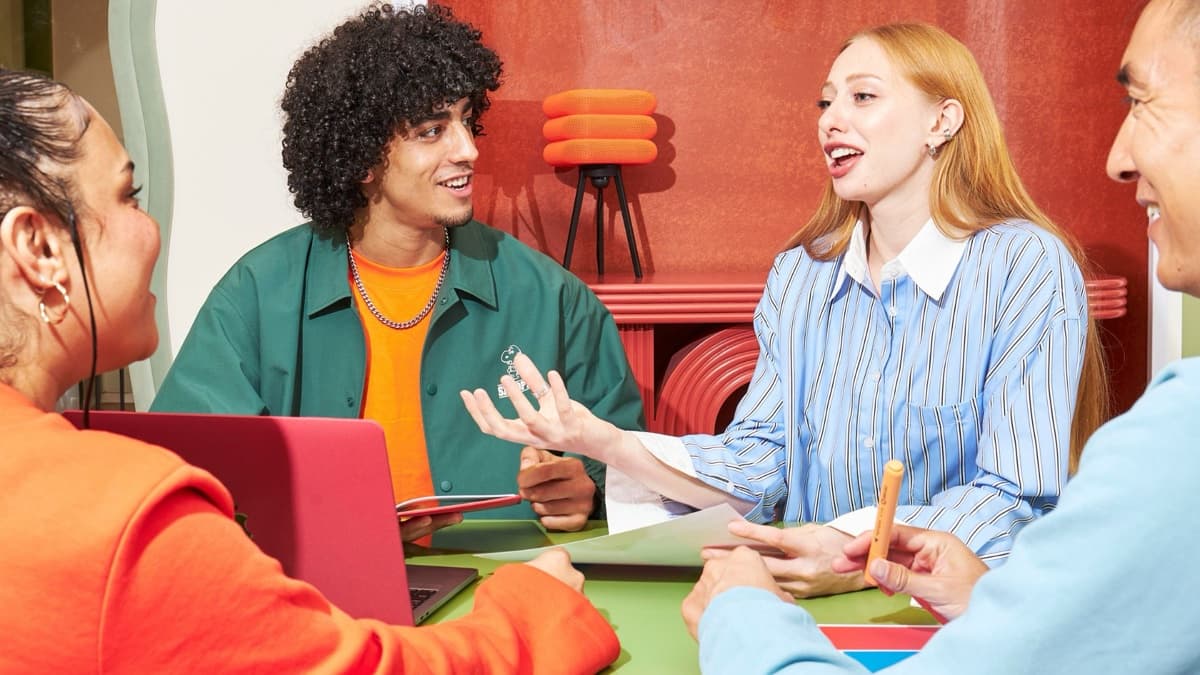

Group dynamics is the way people behave, relate and make decisions once they're part of a group. It covers the roles people take, the unwritten rules they follow and the pressure they put on each other. Group dynamics decides whether a room full of capable people performs well or badly. That's why PowerProv workshops work on the group, not only on the individuals in it.
- Group dynamics is how people behave, relate and decide once they're part of a group.
- Roles, norms, cohesion, status and group size shape the dynamics of every team.
- The best-known theories of group dynamics come from Lewin, Tuckman, Bion, Belbin and Janis.
- Systems psychodynamics looks at the unspoken side of group life, where anxiety drives behaviour nobody planned.
- Poor group dynamics show up as groupthink, social loafing, dominant voices and silence.
- Group dynamics improve through shared experience. PowerProv builds that with the ensemble mindset.
What is group dynamics?
Group dynamics is the pattern of behaviour that appears when people work together. Social psychologist Kurt Lewin is credited with coining the term. His central idea was that behaviour comes from the person and their environment together, so you can't understand how someone acts without looking at the group around them.
You've seen group dynamics at work if you've watched a confident colleague go quiet in one meeting and take charge in another. The person didn't change. The group did.
In simple terms, group dynamics answers three questions about any team:
- Who speaks, and who gets listened to?
- What are the unwritten rules?
- What happens when people disagree?
What shapes group dynamics?
Five things shape the dynamics of any group: roles, norms, cohesion, status and size. None of them appear on an org chart, and all of them affect results.
| Factor | What it means | What it looks like at work |
|---|---|---|
| Roles | The part each person plays, formal or not | The organiser, the challenger, the peacemaker |
| Norms | The unwritten rules | Whether it's normal to question the boss |
| Cohesion | How strongly people feel part of the group | People backing each other, or protecting their own patch |
| Status | Whose opinion carries weight | The room turning to one person before deciding |
| Size | How many people are in the group | Less airtime and less effort per person as numbers grow |
Size deserves a closer look. In a 1979 study, Bibb Latané and colleagues asked people to clap and shout alone and in groups. They put in less effort in a group than they did alone. Latané called it social loafing. Max Ringelmann had found a similar drop decades earlier with people pulling on a rope.
What are the main theories of group dynamics?
Five theories of group dynamics come up most often. Each one explains a different part of how groups behave.
| Theory | Who | The core idea |
|---|---|---|
| Field theory | Kurt Lewin | Behaviour comes from the person and their environment together |
| Stages of group development | Bruce Tuckman | Groups move through forming, storming, norming, performing and adjourning |
| Basic assumptions | Wilfred Bion | Groups often act on unspoken assumptions that pull them away from their task |
| Team roles | Meredith Belbin | Teams need a mix of nine team roles to progress |
| Groupthink | Irving Janis | The wish for agreement can override good judgement |
Tuckman's model is the one most leaders already know. PowerProv covers it in detail in its guide to the stages of development every team goes through.
Bion's idea is the least known in business and one of the most useful. It leads into systems psychodynamics.
What is systems psychodynamics?
Systems psychodynamics is a framework for understanding the unconscious forces that shape behaviour in groups and organisations. The Tavistock Institute of Human Relations in London, where the approach originated, describes the framework this way: beneath formal structures like strategies and hierarchies lie patterns of anxiety, defence and loyalty that influence what people do.
Put plainly, a group has two agendas. One is the task it was given. The other is managing how its members feel, and nobody says that one out loud.
Psychoanalyst Wilfred Bion described this in his book Experiences in Groups. He argued that every group is two groups at once: a work group focused on the task, and a "basic assumption" group acting on an unspoken belief. He named three.
| Bion's basic assumption | The unspoken belief | What it can look like in a team |
|---|---|---|
| Dependency | A leader will take care of everything | Nobody decides until the boss does. Meetings wait for one person's view. |
| Fight-flight | There's a threat to attack or avoid | Blaming another department, or changing the subject when the hard topic comes up |
| Pairing | Someone or something will arrive and fix it | "Once the new hire starts" or "once the restructure lands", and nothing changes now |
The workplace examples in the table are illustrations, not Bion's own. His point holds without them: when a group feels anxious, it stops doing its work and starts protecting itself, and it doesn't notice the switch.
You don't need a psychology degree to use this. You need to notice when your team is busy and avoiding the real task at the same time.
“We laughed, had fun, and were challenged to work together differently and the whole group was involved and participating.”— Andrea B., Umpire, Netball Australia
What do poor group dynamics look like at work?
Poor group dynamics show up as four patterns: groupthink, social loafing, dominant voices and silence. Each one costs a team good decisions.
- Groupthink. In groupthink, the team agrees quickly because agreeing feels better than arguing. Doubts stay unspoken and weak plans go ahead.
- Social loafing. People put in less effort because the group will carry it. Work gets assigned to "the team" and nobody owns it.
- Dominant voices. Two or three people do most of the talking. Their ideas win on volume, not merit.
- Silence. People nod in the meeting and disagree in the corridor. Decisions get made and then quietly reopened.
These patterns feed each other. A dominant voice produces silence. Silence looks like agreement, which produces groupthink. A team can be full of talented people and still decide badly, because the problem sits in the group and not in any one person.
Is group dynamics the same as team dynamics?
In practice, yes. Team dynamics is the workplace term for group dynamics. Psychologists use "group" because the research covers every kind of group, from juries to sports sides. Managers say "team" because that's the kind of group they lead.
The difference that matters is between a group and a team. A group is people who work near each other. A team is people who depend on each other for a shared result. Moving from one to the other takes a change in the dynamics. PowerProv's guide on how to improve team dynamics covers that shift.
How do you improve group dynamics?
You improve group dynamics by changing what the group does together, not by telling it to behave differently. Four moves do most of the work.
- Name the norms. Say how decisions get made and how disagreement should be raised. Unwritten rules lose their grip once someone writes them down.
- Speak last. When the leader gives a view first, the room agrees with it. Ask for other views before you offer yours.
- Make it safe to be wrong. Google's Project Aristotle research found psychological safety was the strongest factor in team effectiveness. A leader who admits a mistake makes it cheaper for everyone else to speak.
- Work in smaller groups. Break a large team into groups of three or four for real work. Effort and airtime go up when nobody can hide.
Each move lowers the anxiety in the room. That's the link back to Bion: a group that feels safe spends its energy on the task.
How does PowerProv change group dynamics?
PowerProv changes group dynamics by giving a team a new shared experience of working together, then naming what made it work.
The foundation is what PowerProv calls the ensemble mindset. It's a "we, not me" way of working. You walk in trusting that the people around you have your back, will support your choices, will help make you look good, and will treat a mistake as something to learn from. When a team works that way, the patterns above lose their fuel. People speak up because it's safe to. Nobody coasts because the group notices and cares.
A PowerProv workshop builds the ensemble mindset through practice. People work in pairs and small groups on exercises where they have to listen, build on each other's ideas and recover from mistakes together. It's fun, and it's introvert-friendly, because the difficulty builds gradually and nobody is put on the spot. It isn't a comedy class. Nobody is asked to be funny.
PowerProv, Personal Power Index™
Those figures come from the Personal Power Index™, PowerProv's ongoing study that measures skills before and after each workshop.
“Even as a virtual workshop, my team got to know each other better, had fun, bonded, and built trust.”— Samantha S., Coordinator, UTS
Bottom line
- The group shapes the person. The same people behave differently in different groups. Fix the group and behaviour follows.
- Every team has an unspoken agenda. Anxiety pulls a group away from its task without anyone deciding to.
- Silence isn't agreement. Groupthink, social loafing and dominant voices all hide behind a calm meeting.
- Dynamics change through doing. Shared experience shifts a group faster than any instruction to collaborate.
PowerProv runs workshops for teams of 10 or more across Australia and APAC, in person and online. It's rated 4.9 stars over 13 years with organisations including Google, Westpac, PwC, Canva and Bain & Co, and every workshop carries a money-back guarantee. Most teams start with a half-day workshop.
Book a discovery call to talk through your team's dynamics, or see how it works first.
Sources
- Systems Psychodynamics · Tavistock Institute of Human Relations
- Many Hands Make Light the Work: The Causes and Consequences of Social Loafing (1979) · Latané, Williams and Harkins, Journal of Personality and Social Psychology
- The Nine Belbin Team Roles · Belbin
- Developmental Sequence in Small Groups (1965) · Bruce W. Tuckman, Psychological Bulletin
- Guide: Understand Team Effectiveness (Project Aristotle) · Google re:Work
- Personal Power Index · PowerProv
Frequently asked questions
What is group dynamics in simple terms?
Group dynamics is how people behave differently once they're part of a group. It covers who speaks and who stays quiet, which unwritten rules everyone follows, how decisions get made and how the group handles disagreement. The same person can be confident in one team and silent in another. Group dynamics is the reason.
What are five theories of group dynamics?
Five of the best known are Kurt Lewin's field theory, Bruce Tuckman's stages of group development, Wilfred Bion's basic assumptions, Meredith Belbin's nine team roles and Irving Janis's groupthink. Each looks at a different part of group life: the forces on a group, how it matures, what it avoids, who does what, and how it decides badly.
What are the five stages of group dynamics?
The five stages come from Bruce Tuckman's model of group development: forming, storming, norming, performing and adjourning. A group starts out polite, moves into open disagreement, agrees how it works, then produces without much refereeing, and finally wraps up. Groups pass through the stages in order, at very different speeds.
How does group size affect dynamics?
As a group gets bigger, each person tends to put in less effort and say less. Researchers call the drop in effort social loafing. In larger groups it's also easier for a few voices to dominate while everyone else waits. Small working groups inside a large team bring individual effort and airtime back up.
What is another word for group dynamics?
Team dynamics is the closest everyday term, and it's the one most workplaces use. Psychologists also talk about group processes or group behaviour. They all describe the same thing: the patterns in how people act and react once they're working together, as opposed to how each person behaves alone.
What is systems psychodynamics?
Systems psychodynamics is a way of understanding the unconscious forces that shape how people behave in groups and organisations. It grew out of the Tavistock Institute's work and draws on Wilfred Bion's studies of groups. Its core idea is that anxiety drives a lot of group behaviour that looks irrational from the outside.
How can a leader improve group dynamics?
Start by lowering the cost of speaking up. Say out loud how decisions get made, invite disagreement before you give your own view, and admit a mistake in front of the team. Then give the group shared work with real stakes. Groups change through doing things together, not through being told to get along.