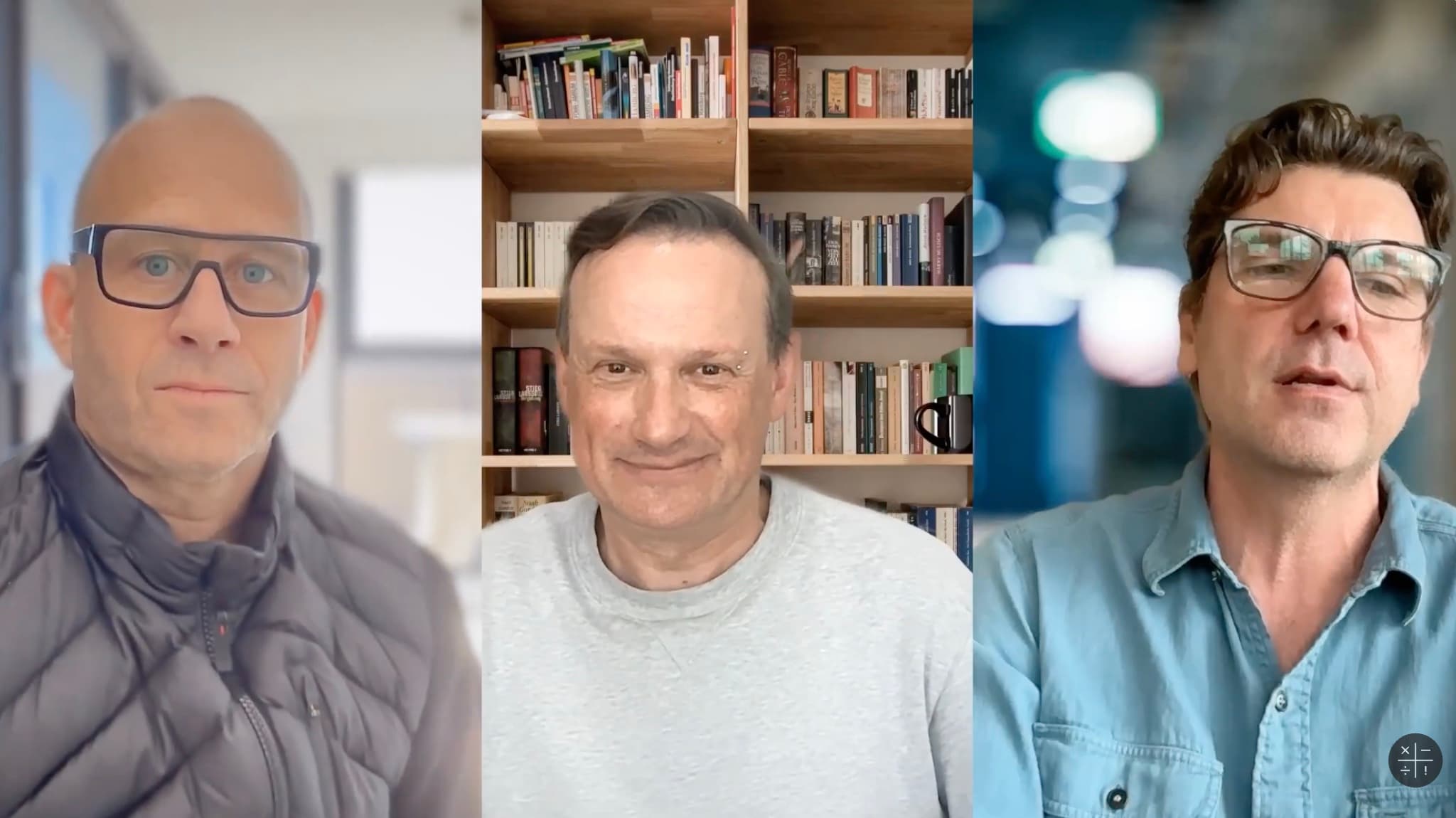
Soft skills are getting weaker in the age of AI, not because people got worse, but because the tools now do the thinking, drafting and remembering that used to keep those skills sharp. PowerProv, Australia's most experienced corporate improv training company, sees it every week: teams who can prompt a model in seconds but struggle to read a room, hold an idea under questioning, or simply look up from the screen. Founder Eran Thomson unpacked why with hosts Matt Perry and Rob Cannon on the Average Robot podcast, and the pattern is worth every leader's attention.
- AI doesn't delete soft skills. It removes the daily practice that keeps them sharp, and unused skills decay.
- Cognitive offloading becomes a problem when people reach for the tool before doing any thinking of their own.
- Global employee engagement sits at 20%, its lowest since 2020, so most teams are starting from a weak base.
- A good AI answer is not the same as good thinking. People who can't explain their work can't defend it.
- The skills AI can't hand you, communication, connection and confidence, are now the ones worth investing in.
- These skills come back through active practice, not slides, which is exactly what PowerProv is built to do.
Why should leaders care about cognitive surrender?
Eran describes two behaviours he now sees inside client teams: cognitive offload, and what he calls cognitive surrender, where people default to the tool before they do any critical thinking of their own. Do that often enough and the muscle wastes. It's the mental version of never going to the gym. PowerProv breaks down the research behind both in cognitive offloading explained.
Leaders should care because the starting point is already low. According to Gallup's State of the Global Workplace report, only 20% of employees worldwide are engaged at work, the lowest level since 2020, and in Australia and New Zealand the figure is just 21%.
Gallup, State of the Global Workplace 2025
Stack cognitive surrender on top of a workforce that's already checked out, and connection doesn't just plateau. It falls.
The room where nobody looks up
Eran tells a story from a workshop with one of the world's largest tech brands. A room full of engineers who work together every day were messaging each other, on their phones, while standing next to each other.
After the session, one of them thanked him and said he finally felt he'd gotten to know his colleagues. Eran assumed the man was a new hire. He'd been there four years.
That's the shift. When PowerProv walks into a room now, the baseline is lower than it was five years ago. People's ability to communicate, to collaborate, even to hold eye contact, has measurably dropped. As Eran puts it, the graph of human connection is trending down. The tools people use to feel connected, Slack, messaging, endless notifications, are the same tools quietly replacing the real thing.
“Even as a virtual workshop, my team got to know each other better, had fun, bonded, and built trust.”

Why a good answer isn't the same as good thinking
Here is the trap that should worry anyone who runs a team. On a recent project, Eran watched a strategy director produce sharp insights at remarkable speed. Everyone knew AI was involved, and nobody minded. But when someone challenged her to explain her reasoning, she couldn't.
The output sounded great and went straight into the deck, but no one had done the thinking behind it. The moment anyone raised a hand to question it, the work started to crack.
It's the school-maths lesson in a suit. The answer matters, but the working is where the learning lives. A team that can only produce answers it can't defend hasn't gotten faster. It's gotten fragile.
Improv has a name for the difference. Editing is being trapped in your own head, second-guessing every move. Auditing is being present, aware, and responsive to what's in front of you. AI makes it easy to skip both and just paste. PowerProv trains people to do the opposite: to stay present, back their instincts, and think on their feet when the script runs out.
The skills AI can't hand you
The tools keep getting better. That's not in dispute. The question is what stays valuable when everyone has the same tools, and the answer is the human layer AI can't replicate.
PowerProv frames it as the five Cs: communication, connection, collaboration, creativity and confidence, with camaraderie as the glue. These are the skills that let a team judge whether an AI output is any good, sell an idea to a sceptical client, recover from a mistake, and trust each other enough to disagree well. None of that comes out of a prompt.
“It's on us as humans to drive it, manage it, and use it. But it will always be the 'we' that makes it work.”— Eran Thomson, Founder of PowerProv
People love to say AI won't take your job, someone who knows how to use it will. Maybe. But the person who knows how to use it well is the one who brings full judgement, experience and human insight to the conversation, and who can still work with the humans around them. For business leaders, that's the skill set with a shelf life.
How PowerProv rebuilds human connection in an AI-heavy workplace
You can't rebuild connection with a slide about connection. You rebuild it by getting people out of their heads and onto their feet, doing things together.
PowerProv starts with what it calls the ensemble mindset, a "we, not me" way of working where everyone agrees to make each other look good. That's the foundation of psychological safety: the felt sense that your colleagues have your back, so you can take a risk, offer a half-formed idea, or admit you're wrong without it costing you.
“Well suited to any organisation that wants to help their teams connect more, improve focus, active listening and have fun.”

From there, the exercises do the heavy lifting. In one, participants present on a topic they know nothing about, to someone who's an actual expert. The lesson lands every time: people rate themselves far lower than the expert rates them. We're our own worst critics, and most of us are far more capable of thinking on our feet than we believe. Practise that in a room full of colleagues, with real stakes and real laughter, and it transfers back to the desk.
It also works. PowerProv's measured team outcomes come from the Personal Power Index™, a longitudinal study that scores participants before and after each workshop, with 98% improving self-confidence, collaboration and thinking on their feet.
- AI is raising the value of human skills, not lowering it. When everyone has the same tools, communication, judgement and connection are the differences that remain.
- The decline is real and measurable. Engagement is at record lows and PowerProv sees connection dropping in the room, year on year.
- Practice beats theory. Soft skills come back through active, on-your-feet reps, which is exactly what a PowerProv workshop delivers.
The teams that win the next few years won't be the ones with the best AI. Everyone will have that. They'll be the ones who kept their people sharp, connected and able to think for themselves. Book a call to talk through your team, or see how it works if you're still weighing it up.
Sources
- State of the Global Workplace 2025 · Gallup
- It's tempting to offload your thinking to AI. Cognitive science shows why that's a bad idea · The Conversation
- The Average Robot Podcast · Average Robot
Frequently asked questions
Does using AI weaken soft skills?
It can, indirectly. AI doesn't remove communication or critical thinking, but it removes the daily reps that keep them sharp. When a tool drafts the email, structures the argument and remembers the detail, people practise those skills less. Skills that go unused decay. The fix is not to ban the tools, it's to deliberately rebuild the human reps somewhere else.
Which human skills matter most as AI spreads?
The ones AI can't hand you: communication, collaboration, confidence, adaptability and genuine connection. PowerProv groups these as the five Cs, communication, connection, collaboration, creativity and confidence, plus camaraderie. These are the skills that let a team judge whether an AI output is any good, and work well together under pressure. They're also the hardest to fake and the slowest to rebuild once lost.
Can soft skills training reverse the decline?
Yes, when the training makes people practise rather than watch. Skills like reading a room or thinking on your feet come back through repeated, active use, not slides. PowerProv workshops get teams on their feet, communicating and making decisions together in real time, which is why the change shows up in measured behaviour afterwards, not just in the moment.
Is PowerProv a comedy workshop?
No. PowerProv uses improv principles, but the goal is professional skill, not laughs. Nobody is learning to perform or be funny. Teams practise communication, listening, quick thinking and collaboration in a fast, genuinely fun environment, and leave with skills they can use the next morning. The fun is real, it's just not the point.
How does PowerProv prove the training works?
Through the Personal Power Index™, an ongoing longitudinal study that measures each participant's skills before and after a workshop. It tracks real behaviour change, not day-of satisfaction. Results include 98% of participants improving self-confidence, collaboration and thinking on their feet, which is how PowerProv can point to outcomes rather than good vibes.
How many people do you need for a PowerProv workshop?
PowerProv runs workshops for teams of 10 or more, in person across Australia and the wider APAC region, or online. Group sizes range from a single team of a dozen up to conference rooms of several hundred. Sessions are introvert-friendly and HR-approved, with no trust falls, no slides and no forced performance.