
- Nearly 1 in 3 Australians feel lonely, and about 1 in 6 feel severely lonely, according to Ending Loneliness Together.
- Whether or not it's an "epidemic", loneliness is a long-term health risk that the World Health Organization links to 870,000 deaths a year.
- Research shows tiny moments of contact with strangers, like a smile, eye contact or a short chat, lift mood and build a sense of belonging.
- Smile is a PowerProv app that tells you when another Smiler is nearby and nudges you both to look up and share a smile.
- PowerProv builds connection at work. Smile helps you find it everywhere else.
Loneliness is real and widespread, with nearly 1 in 3 Australians saying they feel lonely. Experts disagree on whether that makes it an "epidemic". They don't disagree on the fix. People need more real moments with other people.
That's why PowerProv, Australia's #1 corporate improv training company, built an app called Smile. It's the smallest possible step back toward each other: look up, see another person, and smile.
Does Australia Have a Loneliness Epidemic?
Loneliness affects a large share of Australians. In 2023, Ending Loneliness Together released the country's first State of the Nation report on social connection. It found nearly 1 in 3 Australians feel lonely, and ABC News reported that about 1 in 6 feel severely lonely.
Australia isn't unusual. The World Health Organization estimates that around 1 in 6 people worldwide experience loneliness. It's most common among adolescents and young people, but it touches every age group.
Young Australians feel it most. A later Ending Loneliness Together report found 43% of people aged 15 to 25 feel lonely. That's more than 2 in 5 of the people starting uni, starting work and joining your graduate program.
Loneliness isn't the same as being alone. The WHO describes it as the hurt you feel when your relationships don't match what you want or need. You can feel it on a packed train. You can feel it in an open-plan office full of colleagues.
Epidemic or Not, Why Does Loneliness Matter?
Some researchers push back on the word "epidemic". In The Conversation, Trinity College Dublin's Brendan Kelly argues that loneliness rates have been fairly stable for decades. His point is that panic leads to short-term fixes, when loneliness needs a steady, long-term response.
He also says clearly that loneliness is a real problem. The health data backs him up. The World Health Organization links loneliness to around 870,000 deaths a year, along with serious harm to physical and mental health.
So the label matters less than the response. Kelly's own suggestion is simple: be a little kinder, and speak to each other a little more. That's a solution anyone can start on today.
Why Do So Many People Feel Disconnected?
There's no single cause. The WHO lists several drivers of loneliness, including living alone, poor health, weak community infrastructure, big life transitions, and unhealthy use of digital technology.
That last one is easy to spot. Watch any café queue, bus stop or lift. Most people are looking down at a screen, not at each other. Apps are built to hold attention, and every minute spent scrolling is a minute not spent noticing the person standing next to you.
Nobody decided to stop connecting with strangers. It happened one small habit at a time. Which means it can be undone the same way.
Can a Smile From a Stranger Make a Difference?
Yes, and the research is surprisingly strong. Small, brief moments of contact with people you don't know have a measurable effect on how you feel.
In one study, psychologists Gillian Sandstrom and Elizabeth Dunn asked coffee buyers either to be as efficient as possible or to have a genuine interaction with the barista: smile, make eye contact, and have a brief chat. The people who connected felt more positive, and they reported a greater sense of belonging.
In another, University of Chicago researchers Nicholas Epley and Juliana Schroeder asked train commuters to either talk to a stranger or sit in solitude. The commuters who connected reported a significantly more positive trip. Most had predicted the opposite.
That gap between what people expect and what happens is the whole problem. People assume strangers don't want to connect, so nobody goes first. Everyone waits for someone else to look up.
What Is the Smile App?
Smile is an iPhone app that lets you know when another Smiler is nearby. When there's a match, you both get a nudge to look up, spot each other, and share a smile. That's it. That's the whole app.
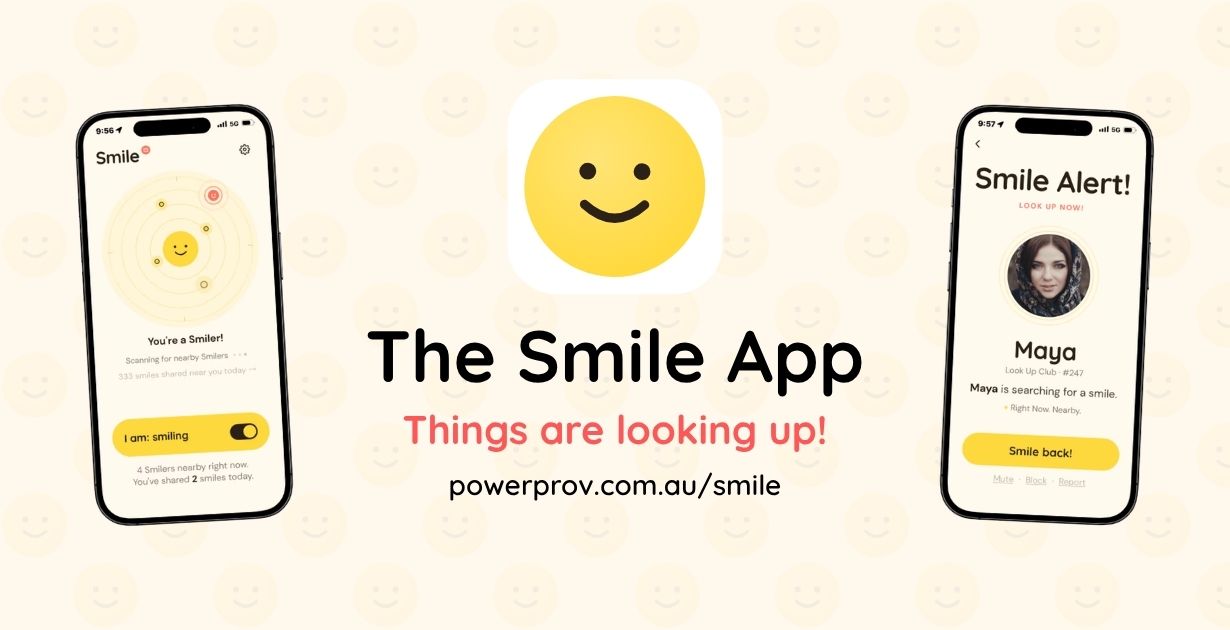
There's no swiping, no chat and no expectations. It's not a dating app or a social network. Other Smilers see your photo and, if you choose, your first name. Nothing else.
PowerProv founder Eran Thomson built Smile because people are feeling lonelier and more disconnected than ever, and because a single smile from a stranger can make your whole day. It's a small, shared moment of being human together. It also removes the biggest barrier the research found: not knowing whether the other person wants to connect. If you both got the nudge, you both do.
Smile works anywhere people are: cafés, commutes, parks and queues. The more Smilers in an area, the more often the nudges happen. It's on the Apple App Store now, and Android users can join the waitlist.
“No swiping. No chat. No expectations. Just quick moments of connection to make your day.”— The Smile app
What About Loneliness at Work?
Work is one of the main places adults see other people, but being surrounded by colleagues doesn't guarantee feeling connected. People can sit next to each other for months and never really know each other.
Gallup's numbers back this up. In its latest workplace report, 22% of employees worldwide said they felt lonely on a given workday, and leaders reported more loneliness than the people they manage.
This is the problem PowerProv solves in the workplace. PowerProv's half-day and full-day team workshops use improvisational tools and techniques to build what PowerProv calls the ensemble mindset. That means everyone in the room trusts that the people around them have their back and will treat mistakes as something to learn from, not something to blame. It's the foundation of psychological safety, and it's what turns a group of co-workers into a connected team.
The results are measurable. PowerProv's Personal Power Index™, an ongoing study of participants before and after each workshop, shows 98% of participants improve in collaboration, listening and professional relationships.
“High energy, totally absorbing and a super-fun way to get us even better connected.”— Gillian R., Content Strategist
As the team puts it: PowerProv helps you create connection at work. Smile helps you find it everywhere else.
What Is Social Prescribing?
Social prescribing is when a GP connects a patient to non-medical activities that build social connection. Think exercise groups, hobby groups and local community services, prescribed alongside regular care.
Australian doctors are getting behind it. The RACGP calls it "a script against loneliness", and the Victorian Government is trialling a program across six regions.
The idea is bigger than medicine. Connection isn't a nice extra. It's something you can plan for, schedule and practise, whether that's a weekly walking group or a team that makes time to get to know each other.
How to Feel Less Lonely: Small Steps to Start Today
You don't need a big plan to feel more connected. Start with the smallest moments, because those are the ones the research says matter.
- Look up. Put your phone away in queues, on public transport and in lifts.
- Smile first. Most people are waiting for someone else to go first.
- Talk to the barista. A brief chat is enough to lift your mood.
- Say hi to a neighbour. Familiar faces build a sense of belonging over time.
- Reach out to someone you've lost touch with. A short text counts.
- Download Smile. Let the app give you a reason to look up.
If loneliness is affecting your mood, sleep or work, talk to your GP or Beyond Blue. Small moments help, but they don't replace real support.
Things Are Looking Up
Loneliness won't be solved by one app, one workshop or one smile. But it gets smaller every time two people notice each other. Download Smile and share one today. And if your team could use more connection at work, book a discovery call with PowerProv.
Sources
- Social Connection in Australia 2023: State of the Nation report · Ending Loneliness Together
- More than 2 in 5 young Australians are lonely · The Conversation
- Social prescribing can be a script against loneliness · RACGP
- Social isolation and loneliness · World Health Organization
- There is no loneliness epidemic, so why do we keep talking as if there is? · The Conversation
- Is Efficiency Overrated? Minimal Social Interactions Lead to Belonging and Positive Affect · Social Psychological and Personality Science
- Mistakenly Seeking Solitude · Journal of Experimental Psychology: General
Frequently asked questions
Does Australia have a loneliness epidemic?
Loneliness is widespread in Australia. Ending Loneliness Together's 2023 national survey found nearly 1 in 3 Australians feel lonely, and about 1 in 6 feel severely lonely. Some researchers argue the word "epidemic" is misleading because rates have been fairly stable over time. Either way, the problem is real and worth acting on.
Is Gen Z the most lonely generation?
Younger people do report loneliness more often than older groups. The World Health Organization says loneliness is most common among adolescents and young people, even though it affects every age. Around 1 in 6 people worldwide experience loneliness, so it isn't only a young person's problem.
What is social prescribing?
Social prescribing is when a GP or other health professional connects a patient to non-medical activities that build social connection, such as exercise groups, hobby groups and local community services. The Royal Australian College of General Practitioners backs it as a way to treat loneliness alongside regular medical care.
How can you tell if you're lonely?
Loneliness is the feeling that your relationships don't match what you want or need. You can feel it in a crowd or in a busy office. If it lasts for weeks, or starts affecting your mood, sleep or work, talk to your GP or contact Beyond Blue for support.
Is the Smile app a dating app?
No. Smile has no swiping, no chat and no matching. It lets you know when another Smiler is nearby and nudges you both to look up and share a smile. That's the whole app. It's designed for brief, friendly moments of human connection with the people around you.
Does the Smile app cost anything?
Smile costs nothing to download or use on iPhone. Android is coming soon, and you can join the waitlist on the Smile page. People who want to support the app can make an optional one-time contribution inside the app.