Gallup's latest State of the Global Workplace report shows employee engagement at its lowest level since 2020 — just 20% of employees worldwide are genuinely engaged at work. The cost: roughly $10 trillion in lost global productivity. Here's what the data shows, and what actually moves it.
- Global employee engagement has fallen to 20% — the lowest since 2020, and the second straight year of decline
- Gallup estimates low engagement cost the world economy roughly $10 trillion in lost productivity
- Daily stress, anger, sadness, and loneliness at work remain well above pre-pandemic levels — Gallup calls it a new, more challenging status quo
- Leaders report more stress, anger, sadness, and loneliness than the people they manage, despite higher life satisfaction overall
- The behaviours that move these numbers are specific and trainable — not abstractions
The Numbers From Gallup's Report
Gallup's 2026 report puts global employee engagement at 20%. That's down from a peak of 23% in 2022, and the lowest level recorded since 2020. It's also the first time in the study's history that global engagement has declined for two consecutive years.
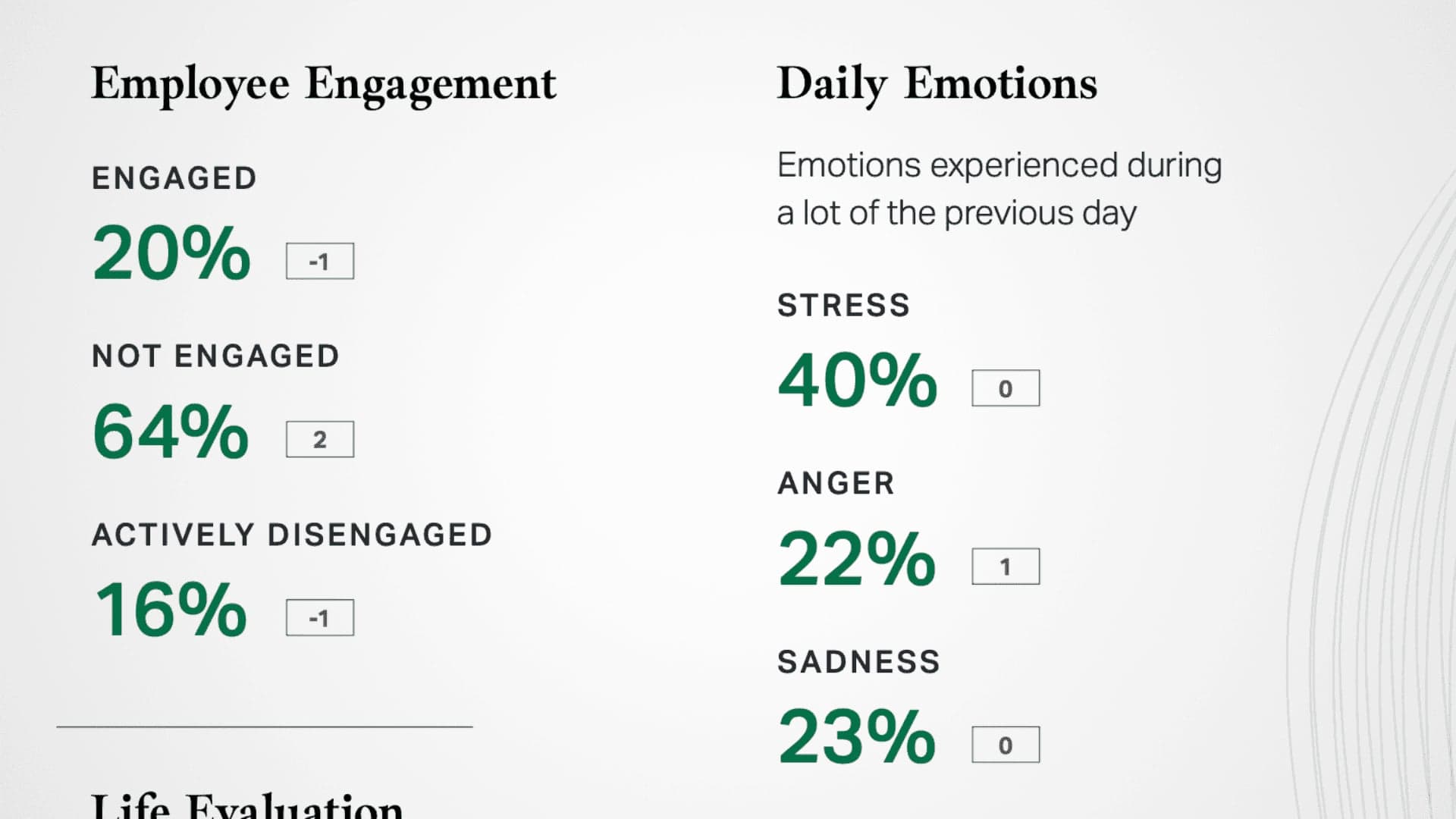
The full breakdown: 20% of employees are engaged, 64% are not engaged, and 16% are actively disengaged.
Gallup, State of the Global Workplace, 2026
Want the raw data? Read Gallup's State of the Global Workplace report straight from the source.
Gallup estimates the resulting drag on the world economy at approximately $10 trillion in lost productivity — about 9% of global GDP. Each percentage point of global engagement represents roughly 21 million employees, which is why a shift of even a few points moves the global economy in a measurable way.
Stress, Anger, Sadness, and Loneliness Haven't Gone Away
The emotional data tells a related but distinct story. Globally, 40% of employees report experiencing a lot of stress on a given workday. 22% report anger. 23% report sadness. 22% report loneliness.
These numbers haven't shifted much in the past year — but that's not good news. Gallup's own analysis is direct: negative emotions at work spiked during the pandemic and have settled at a level still well above where they sat before 2020. The report frames this as "either lasting psychological impacts or a new, more challenging status quo."
Australia and New Zealand sit in an unusual position. Thriving is high — 55%, the second-highest result of any region globally. But daily stress is also high: 49%, well above the 40% global average and the second-highest of any region in the world.
High life satisfaction and high daily stress aren't contradictory — they describe a workforce that's broadly optimistic about the bigger picture, while still under real day-to-day pressure.
The People Leading Teams Are Struggling Most
One of the more striking findings sits in how leaders and managers compare to the people they manage. Leaders report higher life satisfaction overall — but on any given day, they experience more negative emotion than individual contributors: stress is 7 points higher, anger 12 points higher, sadness 11 points higher, and loneliness 10 points higher.
Leadership brings more voice, more agency, and more status. It also brings more social distance and the weight of decisions that affect other people's working lives — and Gallup's data shows that weight clearly. Manager engagement itself has fallen nine points since 2022, with the steepest single-year drop occurring in the most recent year measured.
What Actually Moves These Numbers
Most coverage of this report stops at the data. The numbers get restated, a generic recommendation gets attached — invest in manager development, prioritise wellbeing — and the piece ends there.
The more useful question is what specifically moves these numbers. Gallup's own research consistently points to a small set of trainable behaviours: listening in a way that actually registers with the other person, building on ideas instead of shutting them down, communicating clearly when the pressure is on, and creating genuine connection between colleagues quickly.
These aren't personality traits some people have and others don't. They're skills — and PowerProv's workshops are built specifically around practising them. Participants leave with measurable change tracked by the Personal Power Index™: improved communication, confidence, listening, and collaboration, backed by a money-back guarantee.
If your team's numbers look anything like the ones in this report, book a discovery call and find out what moving them actually looks like.
Or watch how it works first.
Frequently asked questions
What does the latest Gallup workplace report show about employee engagement?
Gallup's State of the Global Workplace report (2026) found that only 20% of employees worldwide are genuinely engaged at work — the lowest level since 2020, and the second consecutive year of decline. 64% are not engaged, and 16% are actively disengaged. The report estimates this disengagement cost the world economy roughly $10 trillion in lost productivity, or 9% of global GDP.
How much does low employee engagement cost businesses?
Gallup estimates that low engagement cost the world economy approximately $10 trillion in lost productivity — about 9% of global GDP. Each percentage point of global engagement represents roughly 21 million employees, which is why even small shifts in engagement have an outsized economic effect.
Is workplace stress actually getting worse, or just staying high?
It's staying high, not spiking. Gallup's data shows daily stress, anger, sadness, and loneliness at work have barely moved year-over-year — but they remain well above pre-pandemic levels. Gallup describes this as either a lasting psychological effect of the pandemic or a new, more challenging baseline for the modern workplace.
Why do managers report more stress than the people they manage?
Gallup's data found that leaders report more daily stress (+7 points), anger (+12 points), sadness (+11 points), and loneliness (+10 points) than individual contributors — despite generally higher life satisfaction. Leadership brings greater voice and status, but also more social distance and the weight of decisions that affect other people's working lives. Manager engagement itself has dropped nine points since 2022.
Can team training actually improve employee engagement?
Yes — when it targets the specific behaviours that drive engagement: listening that actually lands, building on ideas instead of shutting them down, communicating clearly under pressure, and creating genuine connection between colleagues. These are trainable skills, not personality traits. PowerProv's workshops are built around exactly these behaviours, and the Personal Power Index™ shows measurable improvement across hundreds of participants.