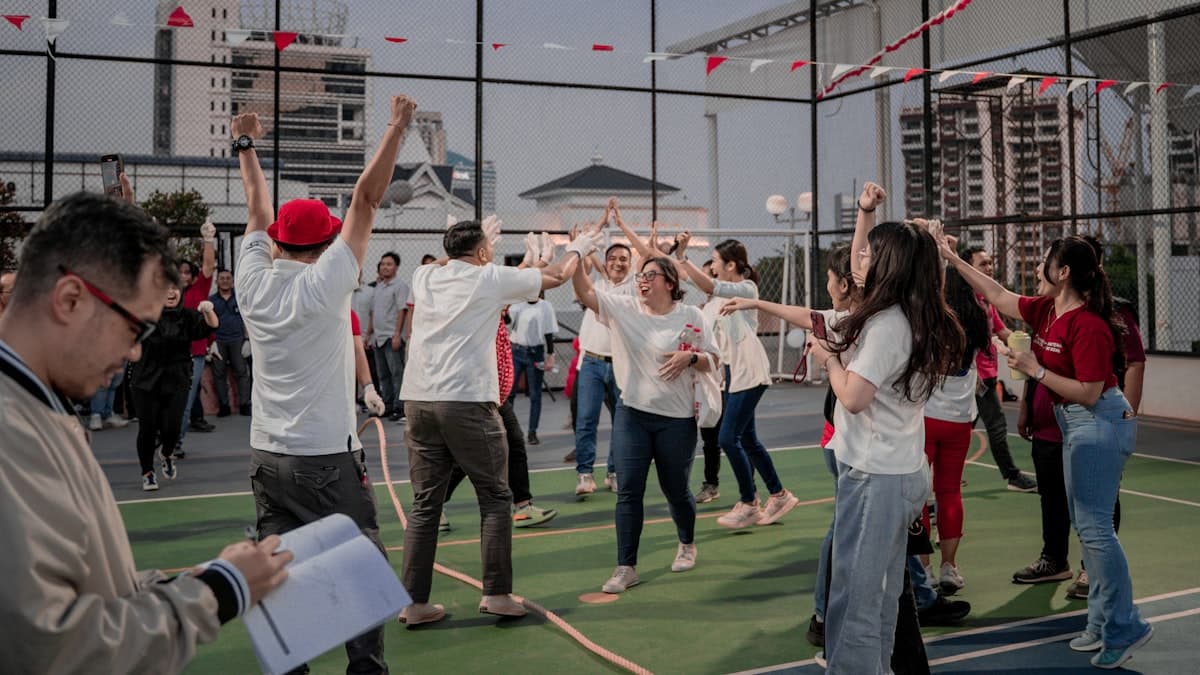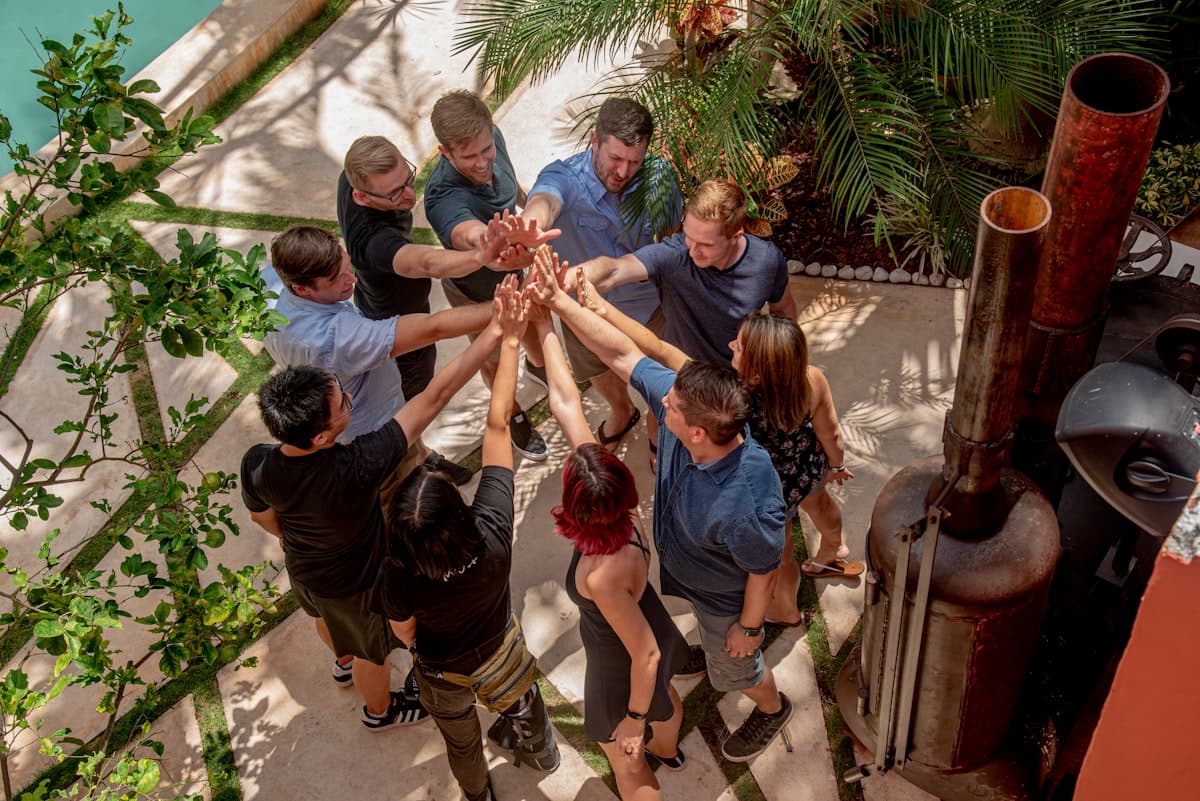
The best team building activities for small groups need no props, no budget and no audience. Everyone takes part. Eran Thomson, founder of PowerProv, has five exercises a small team can run today, and you can download them on us.
Want the full breakdown? There are five free exercises waiting for you below. Click the button to get the PDF, and you'll have everything you need to start running them with your team.
- PowerProv has five exercises a small team can download and run without a facilitator.
- The five are the Name Game, Mirror Me, Yes, Let's!, One-Word Story and Twenty-One.
- In a small group nobody can sit out, so pick activities where everyone takes part together.
- Each exercise builds a real work skill, like listening, focus or building on ideas.
- PowerProv's facilitated workshops are designed for teams of 10 or more.
What Changes When the Group Is Small?
In a small group, everyone is in the activity the whole time. There's no back row. That's the biggest difference, and it's why the choice of activity matters more than it does with a crowd.
Small teams also have an advantage. J. Richard Hackman, the Harvard expert on teams, told Harvard Business Review that leaders should keep teams small, fewer than 10 members, because the effort of managing the links between people grows fast as a team gets bigger.
So a small team doesn't need a big event. It needs short activities that get every person listening, contributing and backing each other.
Which Team Building Activities Suit a Small Group?
These five PowerProv exercises suit a small group because none of them needs props, prior experience or a big room. Mirror Me is done in pairs, and Yes, Let's! works with as few as two people.
| Exercise | What it is | What it builds |
|---|---|---|
| The Name Game | Introduce yourself with an adjective that starts with the same letter as your name | Active listening, observation and team bonds |
| Mirror Me | Pair up and mirror each other's movements | Close attention and non-verbal communication |
| Yes, Let's! | Agree with an idea, then build on it together | Collaboration, creativity and a supportive atmosphere |
| One-Word Story | Tell a story one word at a time, taking turns | Listening and quick thinking |
| Twenty-One | Count to 21 as a group, one person at a time | Focus, coordination and resilience |
One-Word Story and Twenty-One are both harder than they sound. That's the fun of them.
The full instructions for all five are in the download.
Eran also explains the Name Game in his video on ice breakers for work. And if your group would rather stay seated, try one of PowerProv's ice breaker questions.
Why Do Simple Exercises Like These Work?
Simple exercises work because they make people pay attention to each other. Mirror Me is a good example. In a well-known study on the chameleon effect, Tanya Chartrand and John Bargh found that mimicry makes interactions smoother and increases liking between the people involved.
Yes, Let's! does something similar for ideas. It gives a team practice at agreeing first and building second, which is the habit behind good brainstorming.
“Genuinely uplifting and insightful. Absolutely no 'acting out' required. 100% suitable for introverts. Corporate training budget extremely well spent.”

What Should You Avoid With a Small Group?
Avoid anything that puts one person on the spot while the rest watch. In a small group there's nowhere to hide, so an activity that feels like a performance can backfire.
A few other things to steer clear of:
- Activities built for a crowd. If it needs several sub-teams competing, it won't work with a handful of people.
- Winners and losers. A small team has to work together again on Monday.
- Anything that needs acting skills. PowerProv's exercises aren't comedy and nobody has to be funny.
The five PowerProv exercises avoid all three. Everyone does the same thing at the same time, and a mistake only means the group starts again.
When Should You Bring in a Facilitator?
Bring in a facilitator when you want the exercises to turn into lasting skills. PowerProv describes its five exercises as very top-level. They're a taste of what a workshop covers, not a replacement for one.
Eran's invitation in the video is simple: run them with your team, then "when you're ready for the pros to come in and run them for real, we'll be here."
PowerProv's workshops are designed for teams of 10 or more, so a small team gets the most from the download first. When you're ready to bring a larger group together, a facilitated session builds on the same ideas. According to PowerProv's Personal Power Index™, 98% of participants improve their collaboration, listening and self-confidence. For other options, see PowerProv's guide to team building activities.
“It's a safe, fast-paced, mind-expanding environment and gets you thinking differently about how to solve problems.”

- Small groups need activities where everyone takes part. No props, no audience and nobody on the spot. PowerProv's five exercises are built that way.
- Start with the download, then go further. The exercises are a taste. A PowerProv workshop turns them into skills a team keeps.
Ready to go beyond the five exercises? Book a discovery call, or see how it works first.
Read the full video transcript
Team building activities for small groups, or team building games for small groups? I've got you covered. I'm Eran Thomson, founder of PowerProv, Australia's most loved team training provider, and I want to share with you some icebreaker games for small groups and some team building activities for small groups of adults.
So, what are some fun games for a small group? Well, you've come to the right place, because I've got five exercises you can download right now, on us, and run with your team. No strings attached. There'll be a link somewhere down below this video for you to click, and you can get those five exercises right now. Run them with your team and then let us know how you go.
I won't get into each specific one right now because I don't want to spoil the surprise. So check out the PDF and have some fun with these team building activities for small groups. And when you're ready for the pros to come in and run them for real, we'll be here. We'd love to work with you. We love what we do, and we can't wait to share it with you and your team. Thanks for watching.
Sources
- Why Teams Don't Work · Harvard Business Review (interview with J. Richard Hackman)
- The Chameleon Effect: The Perception-Behavior Link and Social Interaction · Journal of Personality and Social Psychology (Chartrand & Bargh, 1999)
- Personal Power Index™ · PowerProv
Frequently asked questions
What are some fun games for a small group?
Five fun games for a small group are the Name Game, Mirror Me, Yes, Let's!, One-Word Story and Twenty-One. PowerProv has written all five up as a download that teams can run themselves. None of them needs props or experience, and each one builds a skill like listening, focus or collaboration.
What are some team-based activities?
Team-based activities are ones a group can only complete together. Two examples from PowerProv's five exercises are One-Word Story, where a team tells a story one word at a time, and Twenty-One, where a group counts to 21 without talking over each other. Both depend on listening to everyone else.
What are some good problem-solving team building activities?
Twenty-One is a good problem-solving team building activity for a small group. The team has to count to 21, one number at a time, and start again whenever two people speak at once. PowerProv includes it in its five downloadable exercises because it builds focus, coordination and persistence through restarts.
How to unite a team at work?
Unite a team at work by giving people a shared experience where everyone takes part and nobody is blamed for mistakes. Short exercises like PowerProv's five downloadable activities are a simple start. For a lasting change, PowerProv's workshops build an ensemble mindset, where teammates support each other's choices and decisions.